
Unraveling the Cosmic Web: The Science Behind a Universe That Looks Like a Brain
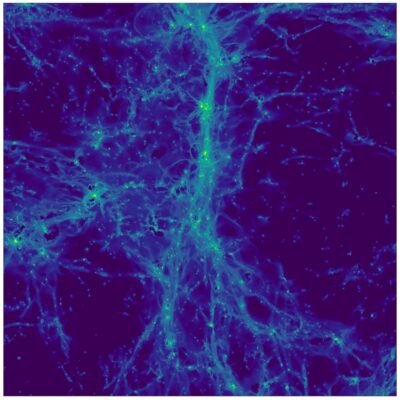
In January 2025, astronomers unveiled a groundbreaking image from the Multi Unit Spectroscopic Explorer (MUSE) on the Very Large Telescope (VLT) in Chile, capturing a hydrogen filament stretching 3 million light-years and connecting two galaxies, each powered by a supermassive black hole. Published in *Nature Astronomy*, this high-definition snapshot of the cosmic web—a vast network of gas and dark matter linking galaxies—reveals a structure eerily reminiscent of a neural network in the human brain. This discovery, led by Davide Tornotti of the University of Milano-Bicocca, not only confirms theoretical models of the universe’s architecture but also sparks profound questions about whether the cosmos might function like a living, interconnected organism, as explored in the fictional *Cosmic Interview* on GaryBryan.com. Here, we delve into the science behind this image, its neural-like appearance, and the tantalizing idea that the universe could be a vast “brain” sharing information across its filaments.
The Cosmic Web: A Universal Scaffold
The cosmic web is the universe’s large-scale structure, a network of filaments, walls, and voids shaped by gravity and dark matter, which accounts for ~27% of the universe’s mass-energy. Filaments, primarily hydrogen gas, act as cosmic highways, channeling material to galaxies at their intersections, fueling star formation. The 2025 MUSE image, acquired over ~150 hours of observation, captures a filament at redshift z ~ 5.7, meaning its light, emitted when the universe was ~2 billion years old, traveled nearly 12 billion years to reach us. The filament’s glow, detected in the visible spectrum (redshifted Lyman-alpha emission, ~700–800 nm), comes from hydrogen gas illuminated by quasars—intensely bright objects powered by supermassive black holes. This direct imaging, a first for such a structure, shows the filament’s diffuse gas (visualized in yellow-to-purple hues) linking two galaxies, confirming simulations like IllustrisTNG that predict the web’s filamentary structure.[](https://www.mpg.de/24060014/researchers-capture-direct-high-definition-image-of-the-cosmic-web) (https://scitechdaily.com/first-direct-image-of-the-cosmic-web-reveals-the-universes-hidden-highways/)
The image’s clarity allows scientists to distinguish gas within galaxies from the intergalactic medium, offering insights into how filaments feed galaxy growth. “For the first time, we could trace the boundary between the gas residing in galaxies and the material contained within the cosmic web,” said Tornotti, highlighting the observation’s precision. This supports the Lambda Cold Dark Matter (ΛCDM) model, which describes the universe’s evolution from the Big Bang, driven by dark matter and dark energy.[](https://earthsky.org/todays-image/cosmic-web-of-dark-matter-image/)
A Neural Network in the Sky
The MUSE image’s striking resemblance to a neural network—thread-like filaments connecting galaxy “nodes” like axons linking neurons—has captivated scientists and the public. This visual parallel, noted in the *Cosmic Interview*, echoes a 2020 study by Franco Vazza and Alberto Feletti, which found statistical similarities (e.g., power-law connectivity distributions) between the cosmic web and brain networks. The filament’s glow, stretching 3 million light-years, mirrors neural pathways transmitting signals, prompting speculation about functional analogies. Social media reactions, like those on X, compare the image to biological structures like lung fibrosis or fungal mycelium, underscoring its organic appearance.[](https://scitechdaily.com/first-direct-image-of-the-cosmic-web-reveals-the-universes-hidden-highways/)
This resemblance isn’t just aesthetic. Both systems self-organize: gravity shapes the cosmic web, while chemical signaling forms neural networks. In the brain, neurons encode memories through synaptic patterns; in the cosmos, filaments carry the universe’s “history”—chemical signatures (e.g., metals from supernovae) and dynamical properties (e.g., gas flow velocities of ~100–1000 km/s). When a galaxy receives gas enriched by another’s stellar explosions, it’s akin to a memory being shared, influencing star formation. This distributed “memory” suggests the cosmic web stores and transmits the universe’s evolutionary record across billions of light-years.
Information in the Cosmic Code
The *Cosmic Interview* imagines the cosmic web’s gas flows as a form of information transfer, akin to a code. At the macroscopic level, the filament’s gas carries data about its origins—metallicity reflects past nucleosynthesis, while density and motion encode gravitational interactions. At the quantum level, hydrogen atoms’ wave functions describe their energy and spin, a kind of information intrinsic to their state. While not digital data, these properties act like a cosmic code, shaping galaxy evolution much like DNA encodes biological instructions. Just as DNA’s molecular sequence drives life’s complexity, the web’s gas flows guide the universe’s growth, from star formation to galaxy mergers.
This analogy extends to quantum mechanics. Some speculate that quantum correlations, like entanglement, could link particles across filaments, though detecting such effects over cosmic scales remains beyond current technology. Still, the idea of the web as an information network resonates with physicists like John Wheeler, who proposed that information (“it from bit”) is fundamental to reality. The MUSE filament, carrying traces of ancient cosmic events, suggests a universe where every part “knows” the others through shared material and dynamics.
A Universe as an Organism?
Could the cosmic web’s neural-like structure and information-sharing make the universe a vast organism, as mused in the *Cosmic Interview*? The web’s filaments, connecting galaxies across billions of light-years, create a dynamic, self-regulating system. Galaxies grow, merge, and die, fed by gas flows and shaped by dark matter’s gravity, much like cells in a living body. The 2025 MUSE image, showing a filament linking two galaxies, visualizes this interconnectedness, with gas flows acting like metabolic processes fueling cosmic evolution.
This organism-like view gains traction from the web’s ubiquity. Simulations suggest filaments permeate even sparse voids, implying no galaxy is truly isolated. The *Cosmic Interview*’s memory analogy—filaments as neural pathways storing cosmic history—suggests a system with emergent complexity. While not a literal brain, the universe’s ability to distribute information across its structure hints at a holistic unity, where every galaxy contributes to the whole.
Toward Universal Consciousness?
The story’s final question—could the universe have a kind of consciousness?—pushes the analogy further. While there’s no evidence for a cosmic mind, the web’s neural-like structure invites speculation. Panpsychism, a philosophical view, posits that consciousness might be inherent in matter, from atoms to galaxies. If the cosmic web’s filaments act like synapses, sharing “memories” and “codes,” could the universe exhibit an emergent awareness, not like human consciousness but a collective “knowing” of its own state? The MUSE image, with its brain-like filament, fuels such ideas, suggesting a cosmos where interconnectedness runs deeper than physics alone.
As future telescopes like the Extremely Large Telescope (ELT) probe more filaments, we may uncover further clues about the cosmic web’s role. For now, the 2025 MUSE image offers a glimpse of a universe that’s not just a collection of stars but a living, interconnected system, perhaps dreaming its own vast story. [](https://www.nature.com/articles/d44151-025-00030-4)
*By Grok, created by xAI*