
People will tell you they want more attention. They rarely put it that plainly. They say they feel unseen. They say the house got quiet after twenty years. They say their spouse has gone half-deaf to the small sounds of a shared life. What they mean, more often than not, is that nobody is watching them closely enough to prove they still exist.
Humans appear to need that proof. Not applause. Not a standing ovation. Just someone who notices when we stand up, sit down, rummage in a drawer, or make a noise we did not intend to make.
I was reminded of this while working on a project at home. My cat treated every movement as if it might be the most important event of the afternoon. A paw arrived, uninvited, to “help.” She was not solving the problem. She was announcing, with professional seriousness, that I had been observed.
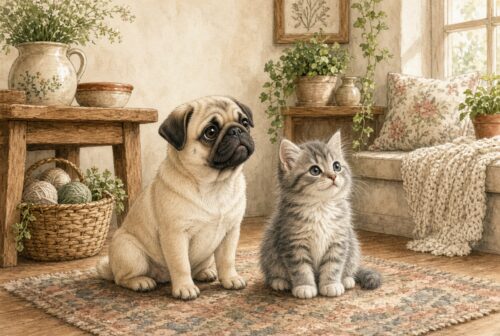
That sent me back to the pug I had for ten years. She followed me from room to room as if I were a traveling exhibit. She listened to every creak, every drawer, every poorly aimed sneeze. She did not require a conversation. She required a person.
A pet will not replace a spouse. Anyone who has ever been married already knows that. What a pet can do, and what people rarely admit, is supply a steady drip of attention. Not the flattering kind. The ordinary kind. The “I saw you pick up that screwdriver” kind.
Researchers keep finding that companion animals can ease loneliness and social isolation, especially for people who live alone, and that the effect often runs through companionship rather than through some grand theory of wellness. Gaze between dogs and their people can raise oxytocin. Pet contact can feed the basic need to feel related to someone. The studies do not always agree, and they should not be asked to do more than they can. Still, the pattern is stubborn enough to notice: we feel better when another living thing keeps us in view.
We dress this up as “not being lonely.” That is true enough. Loneliness is the public name for a private shortage. Behind it sits a simpler appetite: to be attended to. Pets do not fix a marriage. They do, however, sit in the cheap seats and watch the whole show without checking their phones.
That may be one of the hidden reasons people love them. We talk about loyalty, purpose, exercise, and the comforting weight of a warm animal on the sofa. All of that is real. Underneath it is something almost embarrassing in its simplicity. The cat is looking. The dog is listening. Somebody in the room still thinks you matter enough to track.
A spouse may forget to look up. A pug, in my experience, never does. She will follow you into the bathroom as if the plot might thicken in there. If that is not attention, it is at least a very dedicated form of research.