
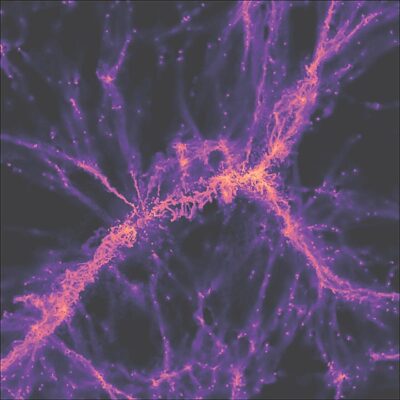
In January 2025, astronomers using the Very Large Telescope’s MUSE instrument captured a stunning image of the cosmic web—a glowing hydrogen filament stretching 3 million light-years, connecting galaxies like threads in a vast network. This fictional interview, inspired by that discovery, follows a curious teen exploring the universe’s mysteries, revealing its uncanny resemblance to a living, brain-like system. A science-based, detailed companion article is here.
The Cosmic Web Interview
**Setting**: A cozy, cluttered attic in a small town, transformed into a makeshift “science studio” by 15-year-old Jamie Carter. Posters of galaxies and neurons plaster the walls, and a laptop screen glows with the 2025 MUSE image of a glowing hydrogen filament stretching across the cosmos. Jamie, a lanky teen with wild hair and a notebook full of scribbled questions, adjusts a microphone. Across from him sits Ms. Cosmo, a quirky astronomer with a penchant for tie-dye shirts and a twinkle in her eye that suggests she’s seen more than just stars. Her real name is Dr. Cassandra Starr, but everyone calls her Ms. Cosmo for her cosmic enthusiasm. Jamie’s launching his new podcast, *Starry Questions*, and Ms. Cosmo is his first guest.
**Jamie**: (grinning, a bit nervous) Okay, Ms. Cosmo, welcome to *Starry Questions*! I’m super pumped you’re here. I saw this crazy photo from the Very Large Telescope—uh, the MUSE thing—showing this glowing filament in space. It looks like a brain’s neural network! Like, seriously, it’s wild. So, what *is* this cosmic web thing in the picture?
**Ms. Cosmo**: (leaning forward, her tie-dye shirt swirling with purples like the filament) Oh, Jamie, you’ve got a good eye! That photo’s a game-changer. The cosmic web is like the universe’s skeleton—filaments of gas and dark matter stretching millions of light-years, connecting galaxies like threads in a giant tapestry. The MUSE image, taken in 2024 and published in 2025, shows a hydrogen filament, about three million light-years long, glowing because two quasars—super-bright black holes—are lighting it up like cosmic flashlights. It’s in the visible light range, redshifted from ultraviolet, so we see it in colors like yellow to purple. Looks brain-like, right? That’s no accident—it’s how the universe organizes itself!
**Jamie**: (flipping through his notebook) Yeah, totally brain-like! I’ve seen pictures of neurons, and it’s, like, uncanny. So, this filament’s caIs it carrying gas between galaxies and sharing information? Like, is it moving information or something, the way nerves send signals in a brain?
**Ms. Cosmo**: (chuckling, adjusting her star-shaped earrings) You’re diving deep already, kid! Okay, let’s unpack that. The filament’s mostly hydrogen gas, flowing at hundreds of kilometers per second, carrying stuff like metals—carbon, oxygen—from one galaxy to another. Think of it like a cosmic river. It’s not “information” like an email, but it’s got *properties*—chemical makeup, temperature, speed—that tell a story. Say a star explodes in Galaxy A, spitting out metals. Those metals ride the filament to Galaxy B, where they spark new stars. It’s like the universe is passing notes about its past!
**Jamie**: (eyes wide) Whoa, so it’s like a memory? Like, the filament’s carrying the universe’s history, the way my brain remembers stuff when I study for a test?
**Ms. Cosmo**: (snapping her fingers) Bingo! That’s a killer analogy, Jamie. In your brain, memories are patterns in your neurons—connections that hold onto experiences. In the cosmic web, filaments carry the universe’s “memories”—its history of star explosions and galaxy collisions, all encoded in the gas’s chemistry and motion. That MUSE filament? It’s got traces of ancient stars from when the universe was two billion years old, 12 billion years ago. When that gas reaches a new galaxy, it’s like recalling a memory, shaping what happens next. The web’s like a cosmic memory bank!
**Jamie**: (scribbling furiously) That’s so cool. But, like, how does it work at the tiny level? I read about quantum stuff—waves and vibrations. Could the gas particles be carrying information, like how DNA carries instructions in our cells? I mean, DNA’s just molecules, but it’s got a code. Is the filament doing something like that?
**Ms. Cosmo**: (leaning back, grinning) You’re hitting the quantum jackpot, kid! Okay, let’s get weird. Those hydrogen atoms in the filament? They’re not just blobs—they’ve got quantum wave functions, like tiny ripples describing their energy, spin, position. That’s information, in a physics sense, like a code about their state. When gas flows through the filament, those quantum properties get shared, like a signal moving through a wire. Now, compare that to DNA—molecules that encode genetic info in their sequence. The filament’s gas encodes a kind of cosmic info—its metallicity, its flow patterns—telling galaxies what’s been happening elsewhere. It’s not a blueprint like DNA, but it’s a record that shapes the universe’s story, like a code for galaxy growth.
**Jamie**: (bouncing in his seat) So, the filament’s like a nerve *and* a memory *and* a code? That’s blowing my mind. Since the MUSE photo looks like a brain, could the whole universe be, like, one giant organism? Like a big brain where galaxies are neurons?
**Ms. Cosmo**: (eyes twinkling, sipping from a mug shaped like a black hole) You’re channeling some big thinkers, Jamie! Scientists like Franco Vazza and Alberto Feletti, back in 2020, compared the cosmic web to a neural network—not just ‘cause it looks similar, but because they share mathy patterns, like how connections spread out. The web’s filaments link galaxies the way axons link neurons, and the gas flows carry “signals” like your memory idea. Now, calling the universe an organism? That’s a leap, but it’s feasible. Gravity and gas flows self-organize the web, like cells self-organize in a body. Galaxies aren’t just sitting there—they’re born, grow, merge, die, all fed by filaments. It’s alive, in a cosmic sense, with every galaxy tied to the whole, like cells in a giant brain.
**Jamie**: (pausing, thoughtful) Okay, but if it’s like a brain, could it… think? I mean, my brain’s got all these connections, and I’m conscious. If the universe is this huge web sharing memories and codes, could it have a kind of consciousness? Like, a universal mind?
**Ms. Cosmo**: (leaning forward, voice softening) Now you’re in the deep end, Jamie, and I love it. Look, there’s no evidence the universe is conscious like you or me. But your idea’s got legs. The cosmic web, with its neural-like filaments—like that MUSE image—distributes information across billions of light-years. Every galaxy’s connected, sharing gas, metals, history. Some physicists, like John Wheeler, say the universe’s info is fundamental—“it from bit.” Others, like panpsychists, wonder if consciousness is baked into matter itself. If the web’s like a brain, storing and sharing cosmic memories, maybe it’s got an emergent something—not a mind like ours, but a kind of awareness, where the whole universe “knows” itself through its connections. That filament you saw? It’s a thread in a tapestry that’s been weaving for 13.8 billion years, linking every part to every other. If that’s not a cosmic mind, it’s the closest thing we’ve got.
**Jamie**: (staring at the MUSE image on his laptop) Whoa. So, when I look at this picture, I’m seeing, like, the universe’s thoughts? That’s… kinda magical.
**Ms. Cosmo**: (smiling warmly) Magical’s the word, kid. That MUSE filament, glowing in visible light, is a snapshot of the universe talking to itself—galaxies sharing their stories, their “memories,” across the cosmos. Keep asking questions like that, Jamie. You’re seeing what the universe might be dreaming about.
**Jamie**: (grinning) Thanks, Ms. Cosmo! I’m definitely gonna tell everyone about this on *Starry Questions*. Next time, can we talk about black holes?
**Ms. Cosmo**: (winking) You got it, star-chaser. Black holes are just the universe’s way of keeping secrets. Until next time!
**Fade out**: Jamie stops the recording, his mind buzzing with visions of a universe alive with connections, its filaments pulsing like thoughts in a cosmic brain. He glances at the MUSE image one more time, wondering if the universe is watching him back.
Based on an actual questions presented to Grok, xAI by Gary Bryan
