
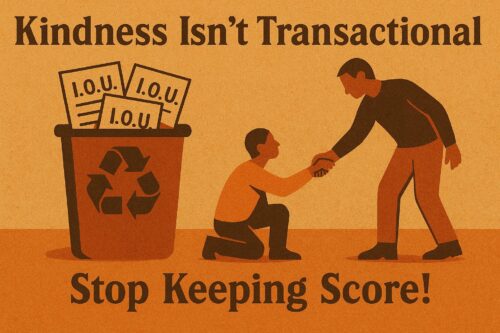
Some People Live Life Like It’s a Giant Ledger
Every favor, every kindness, every slight gets written down in invisible ink. They don’t just remember who did what; they keep a running balance. And God help you if the column marked “owed to me” ever dips into the red.
I call them the Score-Keepers.
You’ve met them.
• The friend who reminds you, twenty years later, that he picked up the bar tab in 2004.
• The relative who prefaces every act of help with “Well, I did do X for you last time…”
• The co-worker who won’t lift a finger unless it’s clear the credit (or the future favor) will come back bigger.
Most of the world treats this mindset as normal, even smart. “That’s just how relationships work,” they say. “Nobody rides for free.” Fairness, reciprocity, quid pro quo—these are the sacred laws of adult life, right?
Maybe.
But watch a Score-Keeper long enough and you’ll notice something: they’re almost never happy. The ledger is never balanced to their satisfaction. There’s always someone who “owes” them, always a fresh injustice to tally. Generosity becomes impossible unless it’s an investment with interest. Love turns into a loan.
I’ve caught the habit in myself more times than I want to admit. The moment I hear that little internal voice say, “Wait a minute, I did this and they never…,” I know the poison has started dripping. The quickest antidote I’ve found is to deliberately do something kind for that exact person with zero expectation of return—and to do it before the sun goes down that same day. It’s like hitting the reset button on the ledger.
Real freedom, at least for me, starts the day I decide the game itself is rigged. There is no cosmic scoreboard. The universe is not fair; it’s abundant. Some people will take more than they give. Some will give far more than they ever take. Trying to force a 50/50 split on every interaction is a fast road to resentment and smallness.
I’d rather burn the book and just play.
If you recognize the Score-Keeper in others, compassion helps. Most of them learned early that love and safety were conditional, so they built a defense system out of tally marks. It feels like survival to them.
And if you catch it in yourself (like I still do), treat it as a yellow warning light, not a life sentence. Notice it, name it, then do the opposite. Give without mentioning. Help without measuring. Love without ledgers.
That’s the only way I’ve found to stay on the right side of the stick—the side that doesn’t need to keep score at all.
What about you? Do you ever feel that internal accountant piping up? I’m curious how you handle it when he does.
(Leave a comment below. No IOUs required.)